Father Steve’s Story of Personal Faith
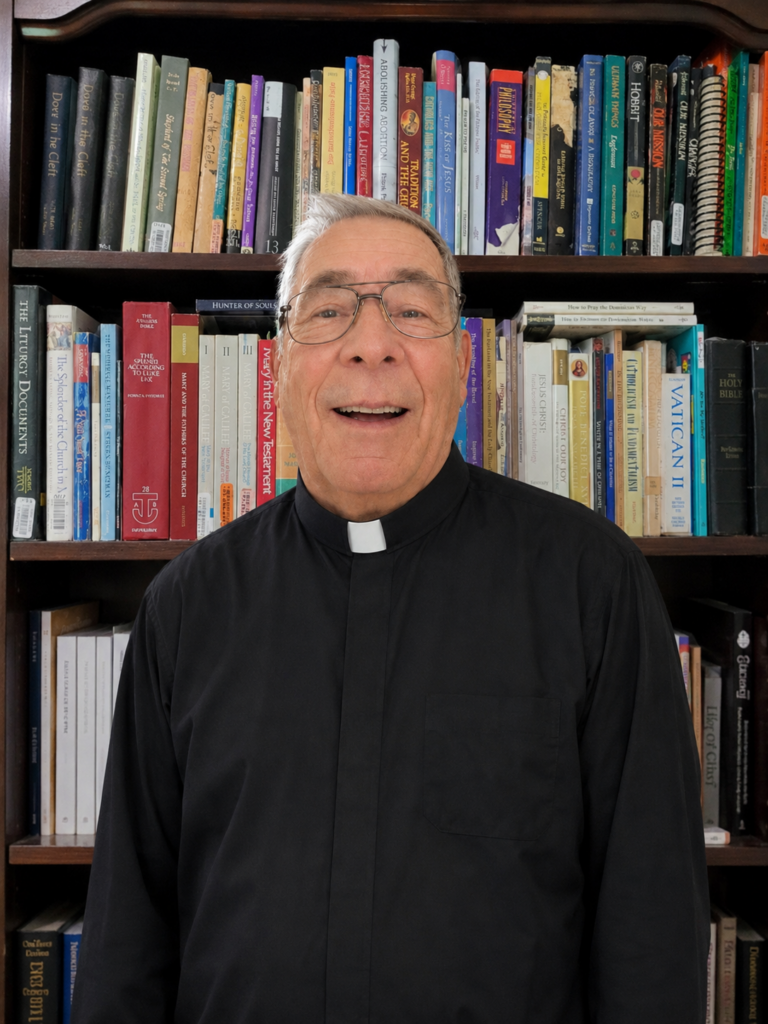
As Co-Founder of Bridge of Mercy Ministries, Father Steve Stolowski is a priest who has always found original and creative ways to evangelize and to serve the poor and needy. He is a retired priest of the Diocese of Nashville, Tennessee, ordained in 1979, who has had a longtime ministry in spiritual direction and who even now continues to share the love of Jesus in his community.
Father Steve Stolowski
Co-Founder of Bridge of Mercy Ministries
A Priest of Practical Faith and Action
Father Steve Stolowski is a retired priest of the Diocese of Nashville, Tennessee, whose ministry has been marked by pastoral courage, direct preaching, Marian devotion, practical ingenuity, and an unwavering conviction that the Gospel must be lived rather than merely discussed. As Co-Founder and member of the Board of Directors of Bridge of Mercy Ministries, he brings decades of priestly experience together with a lifelong ability to identify problems, understand how they work, and take concrete action.
Education and the Call to Priesthood
Father Steve earned his bachelor’s degree in philosophy, with a minor in religious studies, from Saint Meinrad Seminary and School of Theology in Indiana. His undergraduate thesis examined the nature of common sense—an appropriate subject for a priest whose ministry would become known for combining theological reflection with uncommon practicality. He later earned his Master of Divinity from Saint Meinrad in 1979 and was ordained to the priesthood for the Diocese of Nashville on June 22, 1979.
His path to the priesthood was neither automatic nor sentimental. Father Steve initially entered college as a pre-med student, intending to become a doctor. During his first year, however, he became increasingly troubled by the moral disorder he encountered in ordinary college life. At the same time, he noticed that the young Christians who were sometimes dismissed as “Jesus people” behaved with humanity, integrity, and concern for others that distinguished them from the surrounding culture.
A generous priest introduced him to Saint Meinrad, where Father Steve encountered approximately 200 young men living together without the typical 1970’s decadence he had come to expect in other settings. He entered the seminary not because he had already decided to become a priest, but because he believed he could grow closer to God there more quickly. His discernment remained honest and demanding throughout his formation and was not fully settled until he was already a transitional deacon. He had expected to marry, have children, and enjoy the ordinary freedoms of family life. Ultimately, however, he accepted the call to spiritual fatherhood and the sacramental priesthood.
A Vocation Tested by Challenges and Obstacles
Although naturally robust and athletic throughout his life, once running fifteen miles every day with his high school cross-country team, Father Steve has lived since adolescence with epilepsy. After his medical diagnosis was reviewed in Rome, he was approved for admission to priestly ministry. He has faithfully managed it through medication, disciplined routines, and practical adaptations, including memorizing the prayers of the Mass when prolonged reading could trigger seizures. He has always had a special gift for compassion and mercy toward people facing life-changing medical or other limiting conditions.
The Merciful Mechanic and Motoring Samaritan
Even before ordination, Father Steve became known for a form of service that did not usually appear in seminary formation plans. He was an exceptionally capable mechanic. While studying at Saint Meinrad, he repaired and maintained approximately 200 automobiles belonging to seminarians and members of the monastic community, always without charge. During the summers, he worked at an Exxon station and learned quickly enough to become the night mechanic after only about a month.
His mechanical ability reflected something deeper than an interest in engines. Father Steve regarded material things as tools that should serve human needs. He kept an unremarkable but durable 1966 Plymouth for years, repairing it through multiple damage events and various mechanical challenges from his first year in college until the early years of his priestly ministry in the mid-1980’s. The next owners drove it until the car had accumulated approximately 700,000 miles.
Decades of Pastoral Service and Leadership
Father Steve’s pastoral assignments included service as associate pastor of Holy Rosary Catholic Church in Nashville and as pastor of Good Shepherd Catholic Church in Decherd and Our Lady of Lourdes Catholic Church in Springfield. He also ministered the sacraments to the Sisters of Mercy at their Nashville convent and served as priestly chaplain at Lois M. DeBerry Special Needs Facility and the Debra K. Johnson Rehabilitation Center.
Parish Renewal Through Conversion
His arrival at Good Shepherd came early in his priesthood, and it was an exceptionally difficult assignment due to the parish’s extensive rural Tennessee territory. He responded by establishing sound financial leadership, strengthening the parish school, beginning a kindergarten, and helping the parish eliminate its debt within approximately three years. Yet Father Steve did not measure parish health only by buildings, enrollment, or finances. He believed that parish renewal required true conversion and unwavering dedication to Our Lord’s Gospel.
His homilies were therefore direct and challenging. Every sermon had to contain a challenge—not only for the congregation, but for Father Steve himself. He regarded sermon preparation as one of the most prayerful parts of his ministry because it required him to listen carefully for what God wanted said. After preaching a homily, he always destroyed the text so that the next year’s preaching would arise freshly from prayer rather than comfortable repetition.
His no-nonsense approach was a catalyst for evangelization. Father Steve did not pressure people to become Catholic, yet his small-town parish sometimes received approximately thirty converts in a year during the 1980’s. People encountered a priest who took their questions seriously, expected faith to change their lives, and presented Catholicism as a demanding but joyful relationship with Jesus Christ.
A Ministry of Recovery and Human Dignity
Father Steve also became highly skilled in helping people suffering from alcoholism and drug addiction. When he first arrived in rural Tennessee, he recognized that addiction was damaging not only individuals but entire families and the parish community. He studied treatment methods, learned the strengths and weaknesses of available treatment centers, and became an effective interventionist. He personally assisted nearly one-hundred people in entering treatment.
His approach combined firmness with respect for the dignity of the person. After witnessing a group intervention that he considered unnecessarily brutal, he resolved to learn how to help people enter treatment without humiliating them. He understood addiction as a spiritual, emotional, mental, and physical struggle and valued the God-centered principles found in the Twelve Steps.
The Firefighting Priest
Father Steve’s reputation as the “firefighting priest” was equally well earned. Raised around church bells and fire sirens, he became a volunteer firefighter while still a young man. His first major emergency when he was college-aged involved a propane tanker that had flipped on its side on the highway. Young Steve found himself operating a high-pressure hose within close range of the crashed vehicle to keep the tanker cool while everyone else had been evacuated due to the risk of explosion,
For the fun of his hobby of working on cars and his love of firefighting, Father Steve purchased an old 1951 Ward LaFrance fire engine in need of restoration for a bargain price while he was visiting his family in New Jersey and hauled it back down to Decherd, Tennessee. As he continued to spend his personal time tinkering on his own personal fire truck, he never expected that it would lead to another new adventure in serving the Lord Jesus and the people in his community.
Living for the first few years in rural Tennessee, Father Steve noticed the chimneys of burned homes standing throughout the countryside. He initially assumed the houses had been lost because municipal fire departments were too far away. He then learned that some departments would not respond or fight the fire unless property owners could guarantee payment at the driveway while their house was burning down.
Father Steve made it his mission to upgrade his 1951 antique fire truck into a fully functional firefighting machine and equipped it with modern firefighting tools. He used an old truck that people once treated as junk to demonstrate what local citizens could accomplish. Father Steve supported several rural communities with his truck and eventually donated the fully equipped truck to a developing fire department.
He also designed an innovative water-drafting pump that could retrieve large quantities of water from lakes surrounded by steep banks. The device was compact enough to be lowered from a bridge and efficient enough to turn high-pressure water into the greater volume needed for firefighting. At the urging of his bishop, Father Steve independently researched the applicable patent law and applied for a patent, but ultimately decided not to pursue it after only part of the design was deemed patentable.
Marian Devotion, Prayer, and Fasting
Father Steve’s priestly vocation has also been deeply shaped by devotion to the Blessed Mother. Through the witness of a Dominican sister stationed at the Good Shepherd parish school, Sister Margaret Mary, and of parishioners influenced by Medjugorje, he became increasingly committed to the Rosary, Marian intercession, Confession, the Eucharist, and fasting. He and many of his parishioners supported one another in practicing days of prayerful fasting on bread and water, and together they saw prayer and fasting contribute to an atmosphere of conversion within the parish.
His appreciation for Medjugorje was grounded less in extraordinary claims than in the spiritual fruits he observed among those influenced by its messages: renewed prayer, sincere repentance, Eucharistic devotion, fasting, and lives redirected toward Christ. For Father Steve, authentic Marian devotion must always lead to Jesus, greater fidelity to the Gospel, and a more serious sacramental life.
Mercy Beyond Borders: Haiti
His concern for the poor also extended beyond his own parishes. Father Steve became involved in early efforts to establish parish-to-parish relationships between Catholic communities in the United States and Haiti. After seeing the severity of poverty in Haiti, he understood that occasional donations or the sale of handmade goods would not be enough. American parishes needed enduring relationships with Haitian parishes and a commitment to provide regular support.
He became one of the early advocates of what was then called parish-to-parish adoption and is now commonly known as “parish twinning.” He visited parishes, spoke about the conditions in Haiti, and encouraged Catholic communities to adopt and support a sister parish. His concern was not abstract. He had seen hospitals where families were responsible for feeding patients and where those without money or family assistance could be removed from the hospital and abandoned outside in an alley. He was deeply affected by the prospect of encountering suffering people whom he could not simply forsake, and has always been grateful to God and to Mother Teresa’s Missionaries of Charity for establishing their house for the dying shortly before he traveled there for the first time.
A Spiritual Home for Those Who Drift Away
Father Steve’s service and innovation in co-founding Bridge of Mercy Ministries show his willingness to examine his own pastoral experience honestly. He has acknowledged that, while he previously recognized people drifting from the Church and tried to reach them personally, he did not fully understand how deeply some people need the parish to become their spiritual home and family.
Because Father Steve came from a loving and supportive home, the need was not always as visible to him as it might be to someone who had grown up without that nurturing foundation. Rather than defending the limitations of past parish practice, he has allowed this realization to deepen his commitment to the mission of Bridge of Mercy Ministries.
He now speaks strongly about the need for parishes to recognize single Catholic adults, accompany those who feel spiritually displaced, and become authentic communities of Christian belonging. He believes that the Church must do more than wait for people to return. Catholics must recognize those who are slowly drifting away, reach out to them, and make clear that the Church remains their spiritual home.
Christian Simplicity, Gratitude, and the Eucharist
Father Steve is equally concerned about the spiritual dangers of wealth, self-sufficiency, and excessive dependence on financial or institutional security. He believes that material abundance can weaken gratitude and lull people into believing they do not need God or one another. He has often emphasized that it takes relatively little to live and that priests, parishes, and Catholic institutions should guard against allowing money to determine their priorities.
He once told his bishop that his salary could be reduced because he had noticed that increased income was diminishing his gratitude for simple gifts. Influenced strongly by the life of St. Francis of Assisi, Father Steve was convinced that firm dedication to Christian simplicity would help to preserve his soul for freedom, gratitude, generosity, and dependence upon Divine Providence.
The practice of a simple life and a simple faith connects directly to Father Steve’s Eucharistic spirituality. The very meaning of Eucharist is thanksgiving. Father Steve believes that when gratitude for simple blessings disappears, something essential to Christian life is endangered. He admires the spiritual warmth, hospitality, sacrifice, and interdependence he has encountered among priests and communities formed by cultures where people still understand their need for one another, such as our Bridge of Mercy connections with simple communities in India.
Mercy That Boldly Puts Faith into Action
Father Steve therefore brings to Bridge of Mercy Ministries much more than a distinguished history of priestly service. He brings the realism of a mechanic, the courage of a firefighter, the decisiveness of an interventionist, the stewardship of an experienced pastor, the heart of an evangelist, and the humility of a priest still willing to learn.
Whether repairing an automobile, establishing a fire department, confronting addiction, reducing parish debt, supporting a community in Haiti, preaching conversion, or encouraging Marian prayer and fasting, his instinct has remained remarkably consistent: protect what is endangered, repair what is broken, awaken gratitude, and bring people into a living relationship with Jesus Christ.
As co-founder and a member of the Board of Directors, Father Steve helps Bridge of Mercy Ministries remain both spiritually grounded and practically responsible. His life demonstrates the true meaning of mercy. Mercy identifies what must be done regardless of danger and, above all, endeavors boldly to put faith into action.